
Venice AI, founded by cryptocurrency entrepreneur Erik Voorhees, has achieved unicorn status with a $1 billion valuation following a $65 million Series A funding round. The investment was led by Dragonfly and included participation from Coinbase Ventures, F-Prime Capital, North Island Ventures, Morgan Creek, and other prominent backers.周三宣布,这标志着该公司自 2024 年成立以来首次进行外部融资。
这笔资金是在人工智能用户隐私受到高度关注的时期到达的。 Earlier this month, Anthropic abruptly restricted foreign access to two of its newest AI models, while OpenAI faces a class-action lawsuit alleging it shared ChatGPT user data with third parties like Google and Meta through tracking tools such as Meta Pixel and Google Analytics.
"This capital will be used to uphold the First and Fourth Amendments to the Constitution as they relate to mankind’s interaction with AI," Voorhees stated in a post on X (formerly Twitter). The First Amendment protects freedoms including speech, while the Fourth Amendment guards against unreasonable government searches and seizures.
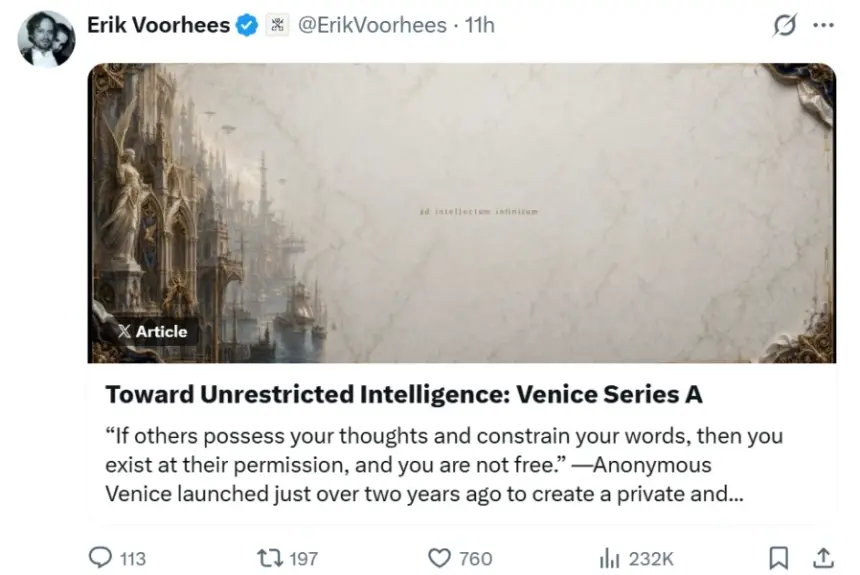
Venice AI 声称为 350 万用户提供服务,并提供对 200 多个人工智能模型的访问。其显着特征是位于用户和人工智能提供商之间的注重隐私的代理层。对于 OpenAI、Anthropic、xAI 和 Google 的模型,代理会屏蔽用户的 IP 地址、帐户详细信息和会话数据。该平台上的其他模型提供了更强的隐私保证。
“对情报的控制是未来十年的决定性斗争,”Dragonfly 管理合伙人哈西布·库雷希 (Haseeb Qureshi) 表示。 “Whoever owns the AI delivery stack owns a direct window into your interior life. They log all your chats, train on them, and will hand them over when asked. And in the end, they decide the terms on which you'll get to access the most powerful systems humankind has ever built.”
Voorhees added that the new capital will primarily fund the development of Venice AI’s own data center infrastructure, enabling the company to own the GPUs powering its platform rather than renting them at premium rates. The remainder will support customer acquisition, market expansion, talent hiring, and strategic acquisitions of “additive businesses.”
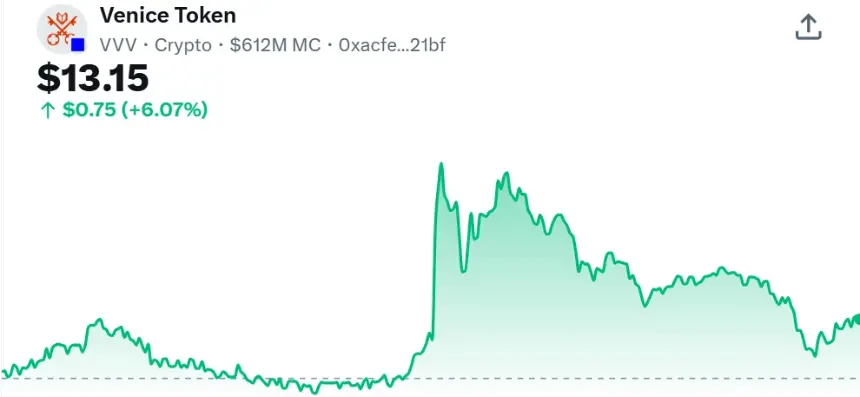
消息发布当天,Venice 代币上涨了 6%,反映出投资者对该平台以隐私为中心的做法的信心。
Privacy concerns around AI have intensified in 2024. Legal experts previously warned that AI chat logs could be used as evidence in court if users seek legal advice from AI systems. In February, Ethereum Foundation AI lead Davide Crapis and co-founder Vitalik Buterin proposed using zero-knowledge proofs to ensure private interactions with large language models.
The recent lawsuit against OpenAI alleges that ChatGPT.com embedded tracking pixels that duplicated user queries—including personally identifiable information—and sent them to Meta and Google for ad targeting, further fueling demand for privacy-preserving alternatives like Venice AI.